

Every big pharma board knows the date its patent cliff arrives. Very few can tell you when their pipeline will refill the gap.
Those are two different clocks. The industry has spent the past two years trying to bring them into line with its chequebook.
Between 2025 and 2030, about $300 billion in branded revenue, roughly a sixth of the industry’s sales, is exposed to loss of exclusivity (PharmaVoice, citing Evaluate). Some 69 blockbusters lose protection in that window (Pharmaceutical Executive). Bristol Myers Squibb alone has Eliquis and Opdivo expiring close together. BMO calls it “the greatest combined exposure” in the sector, with $33 billion at risk from Opdivo alone (BioSpace).
The response so far has been predictable: buy, cut and extend.
I want to argue something less comfortable. None of those three moves solves the patent cliff. They move it. The only durable answer is to fix the place where tomorrow’s replacement products die before anyone has heard of them: the valley of death.
The playbook buys time, not products
Start with acquisitions. BioSpace counted 52 transactions worth around $130 billion in the first half of 2026 alone (via DrugNews). Every one of those deals involves bidding for an asset that has already survived the valley. The pool of such assets is small, and every large company is fishing in it at the same time. That is why prices are so high. It is also why the industry keeps reaching further and earlier, into Chinese biotech licensing and minority stakes, to find anything left to buy.
Acquisition does not create a new medicine. It moves an existing one from one balance sheet to another. For the industry as a whole, it adds nothing.
Cost-cutting is worse. Companies are “drastically pruning their pipelines and workforces” to protect margins (BioSpace). That improves this year’s earnings by cutting into the early-stage programmes that would have filled the next decade.
Life-cycle extension is the most sophisticated of the three, and the most fragile. Subcutaneous Keytruda restarts the patent clock, with coverage through 2041 (BioSpace). Within weeks of that analysis, a Dutch court blocked Merck from making and selling the formulation in eight European countries (BioSpace). Extension strategies are bets on patent courts. They are not a pipeline.
All three tactics have the same flaw. They manage the shortage of new products without increasing the supply of them.
Where the replacements actually die
In my book, Transforming the Pharmaceutical Supply Chain (Wiley), I use a simple model. Start with 250 development candidates. About 245 never leave non-clinical development. Five reach an IND (Investigational New Drug application). Four of those fail in the clinic. One becomes an approved product, about ten years later:
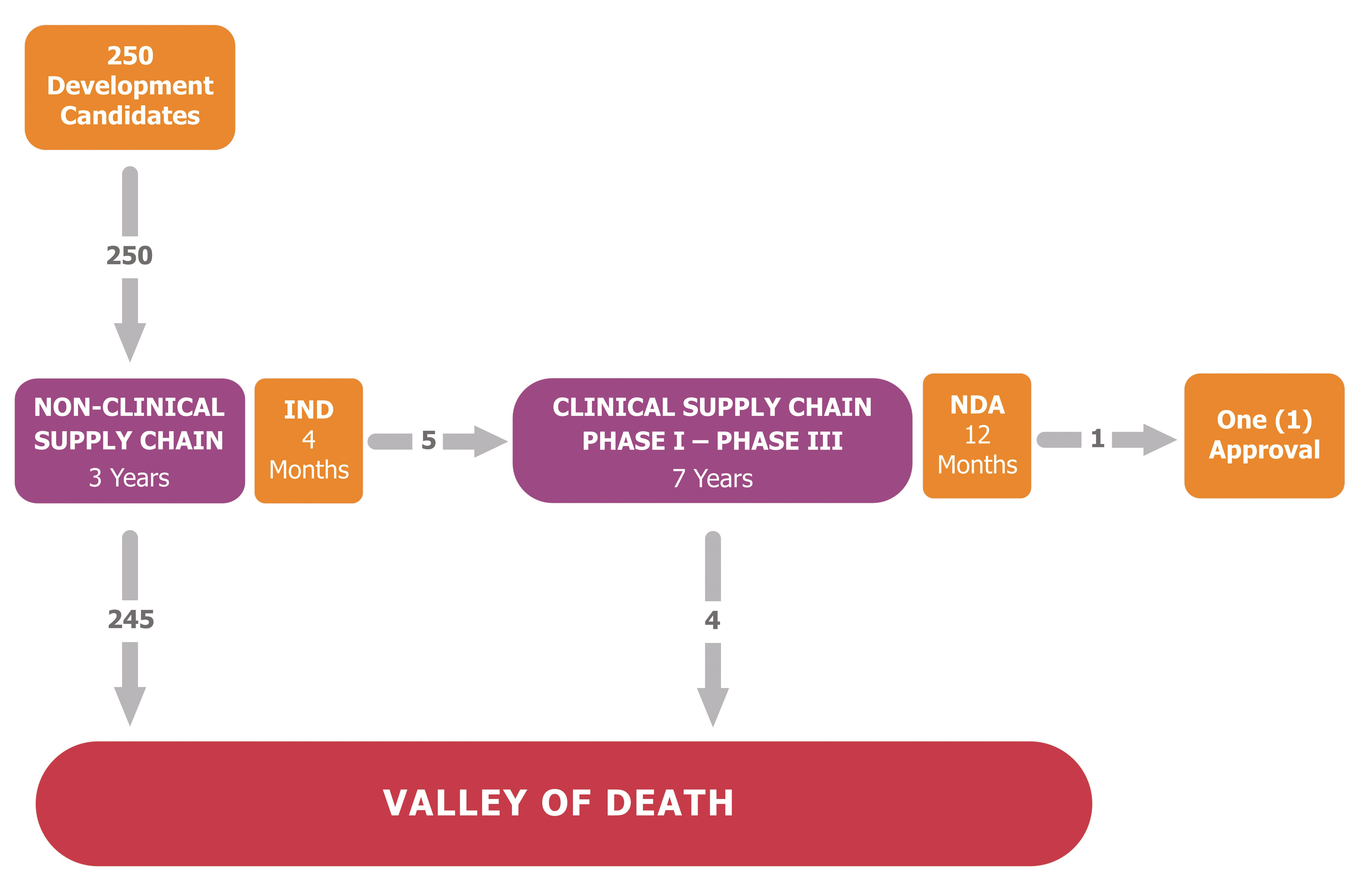
You can argue with the exact ratios. Real-world success rates vary by source and therapy area. You cannot argue with where the losses sit: overwhelmingly before and just after first-in-human dosing.
That is the valley of death. It is the gap between the point where an academic grant or seed round runs out and the point where industry or later-stage venture capital is prepared to step in (Nature Biotechnology). The Milken Institute estimates that basic research receives $22–23 billion a year and industry-funded clinical development about $125 billion. The translational stage in between receives just $7–8 billion (Milken Institute). Only around 3% of venture investment goes to early-stage projects (Expert Opinion on Drug Discovery).
There is also a second valley that gets far less attention. The Alzheimer’s Drug Discovery Foundation describes it as the gap between Phase Ib and Phase IIb, where trials are routinely underpowered because the money runs short (Pharmaboardroom). An underpowered Phase II doesn’t just fail. It produces an ambiguous result that kills a potentially good molecule and teaches nobody anything.
The arithmetic is simple. The supply of approvals in 2035 is decided by how many candidates survive the valley in 2026. If the industry wants more products on the far side of the cliff, it has to lose fewer on the way in.
The valley is not only a funding gap
This is where I part company with much of the commentary, which treats the valley purely as a capital problem.
I have spent my career in development supply chains, working with companies such as Bayer, British Biotech, Vernalis, OSI Pharmaceuticals up to 2005, when I became a to consultant on CMC (chemistry, manufacturing and controls), clinical supply and facility readiness. In my experience, a large share of the candidates that die in the valley are not killed by biology. They are killed by operations.
The molecule could not be made at a scale and standard that would support a filing. The process was developed for a publication, not a regulator. No one planned for stability, comparability or the clinical supply chain until the first Phase I batch was overdue. The small biotech that owned it could not find GMP capacity at a price it could afford. By the time those problems were solved, the cash had run out.
None of this appears in attrition statistics. The industry reports failure by phase, not by cause. “Lack of efficacy” and “strategic decision” absorb a great deal of what was really a CMC or supply failure. We cannot fix a leak we refuse to measure.
What bridging the valley would actually take
If big pharma believes, as its M&A spending suggests, that external innovation is its future, it should invest where that innovation is lost rather than paying a premium for the few assets that survive. Five changes would make a material difference:
1. Fund translation, not just transactions. A fraction of one mega-deal premium, committed to translational funds, bridge financing and Phase II trials that are properly powered, would put far more candidates in play than another bidding war.
2. Build CMC readiness in from the first non-clinical batch. Development supply chains should be designed for the valley. That means scalable processes, early stability work and a credible clinical supply plan before the IND, not after.
3. Use New Approach Methodologies seriously. Non-animal methods, including organ-on-chip and in silico models, can reduce the cost and time of nonclinical work, and regulators are increasingly open to them. Every month and every pound saved in the valley increases the number of candidates that cross it.
4. Ask regulators to reward early quality maturity. The FDA’s Quality Management Maturity programme and the MHRA’s innovation pathways could explicitly credit sponsors and CDMOs (contract development and manufacturing organisations) that build robust quality systems early. Better quality systems mean fewer failures for avoidable reasons.
5. Report attrition by cause. Any large company that publishes how many candidates it loses to supply, CMC and quality failures, as distinct from efficacy and safety, would change this conversation overnight.
The next cliff is being decided now
The current patent cliff is not a surprise. It is the delayed result of underinvesting in translation 10 to 15 years ago. The industry’s response, buying survivors, cutting early research and litigating extensions, risks repeating the same mistake.
Bloomberg Intelligence already expects Keytruda’s real erosion around 2033 (BioSpace). Dupixent loses protection in 2031 (BioSpace). The products that replace them have to cross the valley this year and next.
M&A buys time. Translation creates future products. Only one of those solves the problem.